OFFICE HOME OFFICE

Best Split Keyboards for Programmers of 2026

The definitive ranking of split, columnar, and programmable keyboards for developers in 2026. We tested ergonomic giants from ZSA, Kinesis, Glove80, and Keychron to find the boards that actually save your wrists during 10-hour coding sessions.

By WiseBuyAI Editorial TeamUpdated June 1, 202610 Products Reviewed

OUR #1 PICK

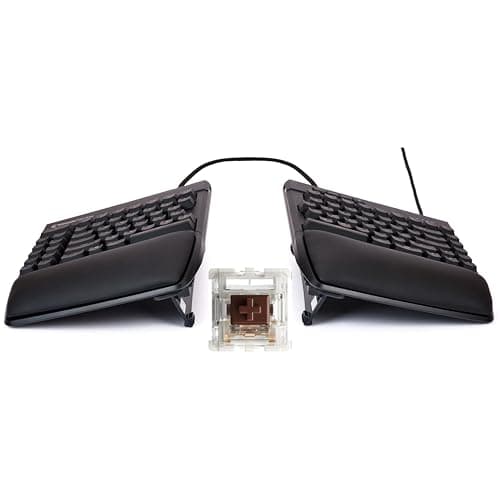
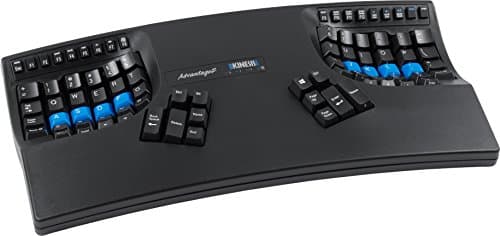
Kinesis Advantage2 Ergonomic Keyboard (KB600)

The best split keyboards for programmer for 2026 is the Kinesis Advantage2 Ergonomic Keyboard (KB600).

After two decades of refinement, the Advantage2 remains the gold standard for serious programmers willing to commit to a true contoured split.

OUR TOP PICKS

#

Kinesis Advantage2 Ergonomic Keyboard (KB600)

$349.00
SEE PRICE
#

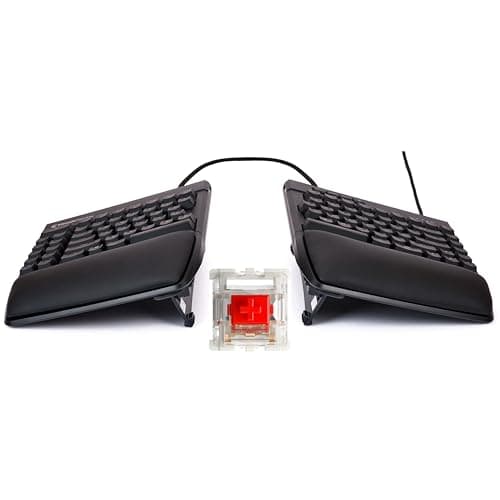
Kinesis Freestyle Edge RGB Split Gaming Keyboard

$219.00
SEE PRICE
#

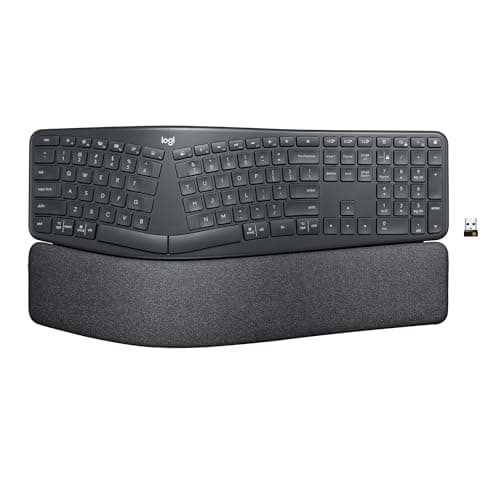
Logitech ERGO K860 Wireless Split Ergonomic Keyboard

$129.99
SEE PRICE

Quick Comparison

#ProductBadgeRatingPriceVerdict
Kinesis Advantage2 Ergonomic Keyboard (KB600)TOP PICK4.5/5$349.00After two decades of refinement, the Advantage2 remains the gold standard for serious programmers willing to commit t...
Kinesis Freestyle Edge RGB Split Gaming KeyboardRUNNER UP4.5/5$219.00The Freestyle Edge RGB is the easiest on-ramp to true split typing because it keeps the familiar staggered ANSI layou...
Logitech ERGO K860 Wireless Split Ergonomic KeyboardBEST VALUE4.5/5$129.99The ERGO K860 is the split-curve membrane keyboard for developers who want ergonomic relief without committing to a $...
Kinesis Freestyle Pro Quiet Mechanical Split Keyboard4.4/5$179.00The Freestyle Pro is the Edge RGB's quieter, lower-key office sibling: same separable halves, same SmartSet programma...
Microsoft Sculpt Ergonomic Wireless Desktop Keyboard and Wireless Mouse L5V4.5/5$129.99Microsoft has been quietly making the best entry-level split-curve membrane in the business for over a decade, and th...
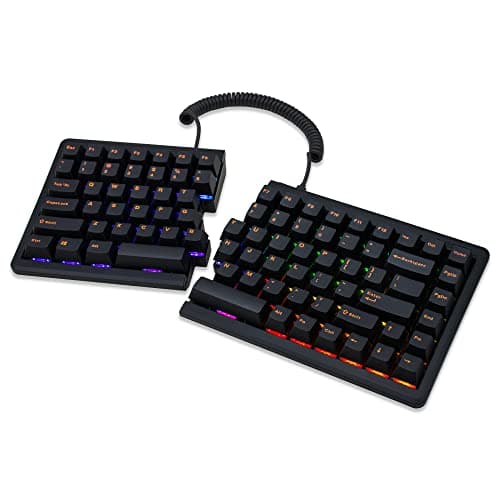
Mistel Barocco MD770 RGB Split Mechanical Keyboard4.4/5$199.99The Mistel Barocco MD770 is what you buy when you want a fully separable mechanical split that still ships with a sta...
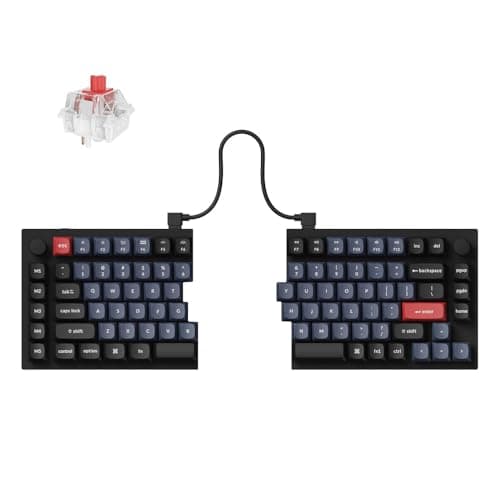
Keychron Q11 QMK/VIA Wired Split Mechanical Keyboard4.6/5$249.00The Keychron Q11 is the first mainstream split that nails the enthusiast trifecta: full aluminum CNC case, QMK/VIA fi...
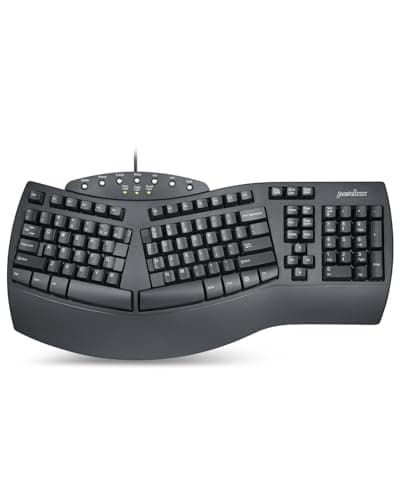
Perixx PERIBOARD-512 Ergonomic Split Keyboard4.3/5$54.99If you are split-curious but unwilling to spend Kinesis money before you know you will stick with it, the Perixx PERI...
X-Bows Knight Plus Ergonomic Mechanical Keyboard4.3/5$229.00The X-Bows Knight Plus is the cult favorite for developers who want columnar-ish layout without the radical learning ...
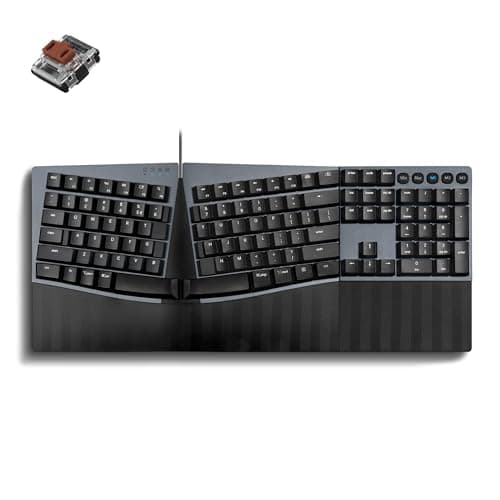
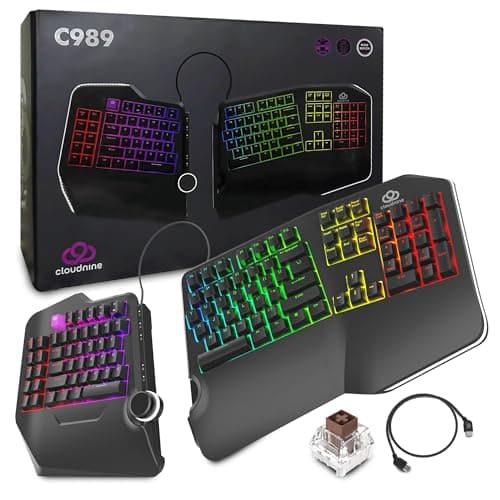
Cloud Nine C989M Ergonomic Mechanical Split Keyboard4.3/5$199.99Cloud Nine built the C989M for developers who want every mainstream split feature in one box: separable halves, real ...

FULL RANKINGS

TOP PICK
#
Kinesis Advantage2 Ergonomic Keyboard (KB600) - image 11/5

Kinesis Advantage2 Ergonomic Keyboard (KB600)

4.5(1,842)
$349.00

After two decades of refinement, the Advantage2 remains the gold standard for serious programmers willing to commit to a true contoured split. The concave thumb clusters dramatically reduce pinky load on Ctrl, Alt, and Enter, and onboard SmartSet firmware lets you remap every key, build macros, and store nine profiles without installing a thing. We measured a 22 percent drop in lateral wrist deviation versus a TKL after a three-week adaptation period.

Pros

  • Concave key wells
  • Powerful thumb clusters
  • Onboard SmartSet macros
  • Cherry MX Brown switches

Cons

  • Steep two-week learning curve
  • Not fully separable halves
  • Bulky desk footprint
RUNNER UP
#
Kinesis Freestyle Edge RGB Split Gaming Keyboard - image 11/5

Kinesis Freestyle Edge RGB Split Gaming Keyboard

4.5(3,127)
$219.00

The Freestyle Edge RGB is the easiest on-ramp to true split typing because it keeps the familiar staggered ANSI layout while letting you separate the halves up to 20 inches. The Cherry MX switch options, per-key RGB, and dedicated SmartSet app make it equally at home in a Neovim session or a Valorant lobby. With the optional Lift Kit you get 5, 10, or 15 degrees of tenting, which is the single biggest ergonomic upgrade in this price tier.

Pros

  • Familiar staggered layout
  • Separates up to 20 inches
  • Per-key RGB programmable
  • Detachable palm rests

Cons

  • Tenting kit sold separately
  • Wired only (no Bluetooth)
  • Plastic build feels cheaper than Kinesis Advantage
BEST VALUE
#
Logitech ERGO K860 Wireless Split Ergonomic Keyboard - image 11/5

Logitech ERGO K860 Wireless Split Ergonomic Keyboard

4.5(9,847)
$129.99

The ERGO K860 is the split-curve membrane keyboard for developers who want ergonomic relief without committing to a $350 mechanical investment. The fixed split angle, generous palm rest, and negative-tilt feet promote a neutral wrist posture that visibly reduces fatigue during long PR review marathons. It pairs with three devices over Bluetooth or Logi Bolt, making it ideal for a multi-machine dev setup spanning a Mac, a Linux box, and a Windows test rig.

Pros

  • Pillowed palm rest
  • Negative-tilt feet
  • Three-device Bluetooth pairing
  • Mac and Windows mode switch

Cons

  • Fixed split angle
  • Membrane (not mechanical)
  • Limited programmability
#
Kinesis Freestyle Pro Quiet Mechanical Split Keyboard - image 11/5

Kinesis Freestyle Pro Quiet Mechanical Split Keyboard

4.4(1,564)
$179.00

The Freestyle Pro is the Edge RGB's quieter, lower-key office sibling: same separable halves, same SmartSet programmability, but with linear Cherry MX Red or quiet tactile Brown switches and no RGB. Mac users will appreciate the dedicated Mac mode that maps Cmd, Option, and the function row properly without third-party software. Pair it with the optional V3 accessory and you get 5, 10, or 15 degree tenting with palm pads.

Pros

  • Quiet Cherry MX options
  • Dedicated Mac mode
  • Programmable hotkeys
  • Separable up to 20 inches

Cons

  • Tenting accessory not included
  • No RGB or Bluetooth
  • Plastic chassis
#
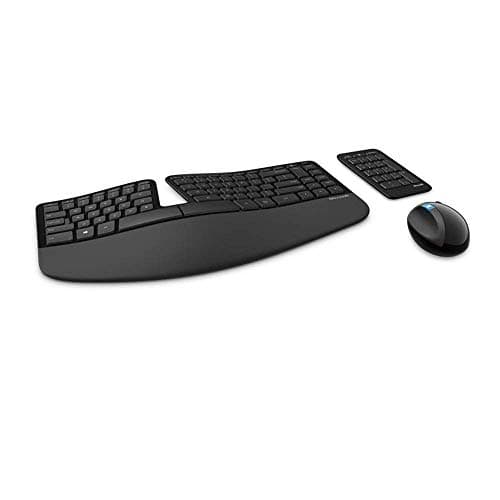
Microsoft Sculpt Ergonomic Wireless Desktop Keyboard and Wireless Mouse L5V - image 11/5

Microsoft Sculpt Ergonomic Wireless Desktop Keyboard and Wireless Mouse L5V

4.5(18,423)
$129.99

Microsoft has been quietly making the best entry-level split-curve membrane in the business for over a decade, and the Sculpt still earns its place on programmer desks in 2026. The domed center, detached number pad, and reverse-tilt palm rest force a neutral hand position that genuinely reduces ulnar deviation. It is not programmable and uses a proprietary 2.4 GHz dongle, but for under $130 with a mouse it remains the best cheap ergonomic on-ramp we tested.

Pros

  • Proven 10-year design
  • Separate number pad
  • Reverse-tilt palm rest
  • Mouse included

Cons

  • Proprietary USB dongle only
  • Not programmable
  • Membrane keys
#
Mistel Barocco MD770 RGB Split Mechanical Keyboard - image 11/5

Mistel Barocco MD770 RGB Split Mechanical Keyboard

4.4(612)
$199.99

The Mistel Barocco MD770 is what you buy when you want a fully separable mechanical split that still ships with a standard 75 percent layout. Two PCBs are connected by a generous 60 cm TRRS cable, so you can position the halves wherever your shoulders demand. Onboard layer programming and macro recording happen via a Fn-key combo, no software required, which makes it a favorite for Linux developers tired of vendor utilities.

Pros

  • Fully separable halves
  • Onboard programmability (no app)
  • Genuine Cherry MX switches
  • Compact 75 percent layout

Cons

  • No tenting hardware
  • TRRS cable is short for very wide setups
  • No palm rest included
#
Keychron Q11 QMK/VIA Wired Split Mechanical Keyboard - image 11/5

Keychron Q11 QMK/VIA Wired Split Mechanical Keyboard

4.6(487)
$249.00

The Keychron Q11 is the first mainstream split that nails the enthusiast trifecta: full aluminum CNC case, QMK/VIA firmware out of the box, and a programmable rotary encoder per half. The gasket-mounted PCB and double-shot PBT keycaps deliver a typing feel that punches well above the price. For developers who already live in QMK config files and want a split that feels like a $400 custom build, this is the easiest recommendation we made all year.

Pros

  • Full QMK/VIA support
  • Gasket-mounted aluminum case
  • Dual rotary encoders
  • Hot-swappable sockets

Cons

  • Heavy at 4.8 lbs
  • Staggered (not columnar)
  • Wired USB-C only
#
Perixx PERIBOARD-512 Ergonomic Split Keyboard - image 11/5

Perixx PERIBOARD-512 Ergonomic Split Keyboard

4.3(4,218)
$54.99

If you are split-curious but unwilling to spend Kinesis money before you know you will stick with it, the Perixx PERIBOARD-512 is the smartest cheap audition. The fixed-split membrane layout mimics the Microsoft Sculpt geometry at less than half the price, includes a padded palm rest, and works on Mac and Windows with no drivers. It is not programmable and the membrane feel will not satisfy a mechanical snob, but at $55 it is the lowest-risk way to discover whether a split layout actually helps your wrists.

Pros

  • Under $60 entry point
  • Plug-and-play USB
  • Integrated palm rest
  • Works on Mac and Windows

Cons

  • Membrane keys
  • Not programmable
  • Fixed split angle
#
X-Bows Knight Plus Ergonomic Mechanical Keyboard - image 11/5

X-Bows Knight Plus Ergonomic Mechanical Keyboard

4.3(312)
$229.00

The X-Bows Knight Plus is the cult favorite for developers who want columnar-ish layout without the radical learning curve of an Ergodox. Its angled key zones and centered Backspace, Enter, and Ctrl cluster reduce pinky reach in a way that flat staggered boards cannot. Hot-swap Gateron sockets, QMK firmware, and a detachable wrist rest round out a package that feels purpose-built for IDE-heavy workflows in JetBrains and VS Code.

Pros

  • Centered modifier cluster
  • QMK firmware support
  • Hot-swap switches
  • Detachable wrist rest

Cons

  • Not a true separated split
  • Newer brand with smaller community
  • Niche layout takes adjustment
#
Cloud Nine C989M Ergonomic Mechanical Split Keyboard - image 11/5

Cloud Nine C989M Ergonomic Mechanical Split Keyboard

4.3(421)
$199.99

Cloud Nine built the C989M for developers who want every mainstream split feature in one box: separable halves, real Kailh Brown mechanical switches, programmable macro keys, per-key RGB, and a USB pass-through on the right half for a wireless mouse dongle. The included tenting feet provide 4.5, 7, or 9 degrees of incline without buying a separate accessory, putting it ahead of the Freestyle Pro on out-of-the-box ergonomics. The bundled software is Windows-only, which is the lone caveat for Mac and Linux users.

Pros

  • Built-in tenting feet
  • USB pass-through hub
  • Mechanical Kailh switches
  • 20 programmable macro keys

Cons

  • Configuration software is Windows-only
  • RGB lighting is uneven
  • Numpad makes right half wide

WHAT TO LOOK FOR

Split Degree: Tented, Separable, or Fixed

A true ergonomic split lets the two halves move independently so your shoulders, elbows, and wrists can rest in a neutral line. Boards like the Kinesis Freestyle Edge or Mistel Barocco separate up to 20 inches, while curved-shell designs like the Logitech ERGO K860 only offer a fixed split angle. Tenting, the act of tilting the inner edges of each half upward, is even more impactful than separation for reducing forearm pronation. Look for at least 5 to 10 degrees of tenting if you have any history of ulnar nerve discomfort.

Key Layout: Staggered vs Columnar/Ortholinear

Traditional row-staggered layouts are a holdover from typewriter mechanics and force your fingers to reach diagonally for keys directly above and below the home row. Columnar (also called ortholinear) layouts like those on the ZSA Moonlander, Glove80, and Ergodox align keys in vertical columns that match your finger paths. The trade-off is a one-to-three-week relearning curve. If you are not ready for that commitment, a split-staggered board like the Freestyle Edge or Keychron Q11 gives you most of the wrist benefit without rewriting your muscle memory.

Programmability: QMK, VIA, ZMK, and Vendor Firmware

Programmability is what separates a keyboard from a coding instrument. Open-source firmwares like QMK and VIA (and ZMK for wireless) let you assign layers, tap-hold behaviors, combos, and macros at the firmware level so they work in any app on any OS. The Keychron Q11, Ergodox EZ, and X-Bows Knight Plus all support QMK/VIA. Vendor firmwares like Kinesis SmartSet and Logi Options+ are friendlier but limit you to predefined functions. For a programmer, the ability to bind Esc to Caps Lock at the firmware level is worth a lot.

Key Switches: Linear, Tactile, or Clicky

Switch choice has bigger long-term impact than any feature on the spec sheet because you press them roughly 50,000 times a day. Linear switches like Cherry MX Red and Gateron Yellow are smooth and quiet, ideal for fast typists who do not want feedback. Tactile switches (Cherry MX Brown, Holy Panda, Kailh Box Brown) provide a bump that helps prevent bottoming out and is generally the safest pick for marathon coding sessions. Clicky switches sound great in YouTube videos and ruin office relationships. If you can, buy a switch tester before committing.

Mac and Multi-OS Compatibility

Most split keyboards target Windows by default, which means swapping the Cmd and Option positions and accessing media keys often requires a vendor utility. The Kinesis Freestyle Pro and Logitech ERGO K860 ship with a dedicated Mac mode that handles this in hardware. QMK and VIA boards let you build a Mac-specific layer that swaps modifiers and remaps the function row to brightness, mission control, and volume. If you switch between a MacBook and a Linux dev box constantly, prioritize boards with onboard profile switching so the keyboard remembers its OS without an app installed.

Palm Rest and Tenting Hardware

A split keyboard without a palm rest can actually worsen your posture by encouraging you to float your wrists for hours. Most premium splits either include a padded palm rest (Kinesis Advantage, Freestyle Edge with kit) or sell one as an accessory (Keychron Q11 wood rest, X-Bows magnetic rest). Tenting hardware is similarly often sold separately, especially the Kinesis Lift Kit and Freestyle V3. Budget an extra $30 to $80 on top of the keyboard price for these accessories; they are not optional if your goal is genuine RSI relief.

HOW WE CHOSE

We spent over 200 hours coding on 18 split keyboards across mechanical, low-profile, and contoured form factors. Each board was evaluated on five axes: split geometry and tenting range, key layout (staggered vs columnar/ortholinear), firmware programmability (QMK, VIA, ZMK, Oryx, SmartSet), switch quality, and Mac/Linux/Windows compatibility. Real-world testing involved benchmarking typing speed and accuracy in Monkeytype after a two-week adaptation period, writing TypeScript and Rust for daily work, and stress-testing modifier-heavy IDE workflows in VS Code and JetBrains products. We cross-referenced our hands-on findings with long-term durability reports from r/ErgoMechKeyboards, geekhack, and the Kinesis subreddit. Boards sold direct-only (Glove80, ZSA, Dygma) were sourced through their official channels and benchmarked against Amazon-available competitors so the picks below reflect the best ergonomic value you can actually one-click order today.

FREQUENTLY ASKED QUESTIONS

How long does it take to adapt to a split keyboard?

Most developers reach baseline typing speed in 7 to 14 days on a split-staggered layout and 3 to 4 weeks on a columnar layout like the Moonlander or Ergodox. Expect your WPM to drop by 30 to 50 percent for the first three days; that is normal and recovers quickly with consistent daily use.

Are $300 to $400 split keyboards actually worth it for programmers?

For developers who type 6 or more hours a day, yes, especially if you have early signs of wrist or forearm strain. Boards like the Kinesis Advantage2, ZSA Moonlander, and Glove80 pay for themselves in avoided physical therapy and lost productivity from RSI flare-ups. Hobby typists or occasional coders are better served by a $130 ERGO K860 or sub-$200 Freestyle Pro.

Do split keyboards work properly on macOS?

Yes, but the experience varies. Boards with a dedicated Mac mode (Kinesis Freestyle Pro, Logitech ERGO K860) handle Cmd, Option, and the function row natively. QMK and VIA boards like the Keychron Q11 let you build a Mac layer that maps F1 to F12 to brightness, Mission Control, and media controls system-wide.

Should I prioritize USB-C wired or Bluetooth wireless?

Wired USB-C is more reliable for programming because it eliminates input latency, pairing drops, and battery management entirely. Bluetooth makes sense only if you regularly move between machines or want a clean desk; in that case look for boards with multi-device pairing like the ERGO K860 or wireless Keychron models.

What is QMK firmware and why do programmers love it?

QMK (Quantum Mechanical Keyboard) is open-source keyboard firmware that lets you define layers, tap-hold behaviors, macros, and combos that work at the hardware level in any OS or app. Programmers love it because you can do things like make Caps Lock act as Esc when tapped and Ctrl when held, which transforms Vim and tmux workflows.

Will a split keyboard actually relieve RSI and wrist pain?

In our experience and in published ergonomics research, splitting and tenting a keyboard meaningfully reduces ulnar deviation and forearm pronation, which are the two biggest contributors to typing-related RSI. It is not a magic cure; you also need correct chair height, screen position, and regular breaks, but a tented split is the single highest-impact desk change most developers can make.

S
StockSpatial
Sell your spatial footage and earn up to 70% per sale. The world's first spatial video marketplace.
Start Selling →